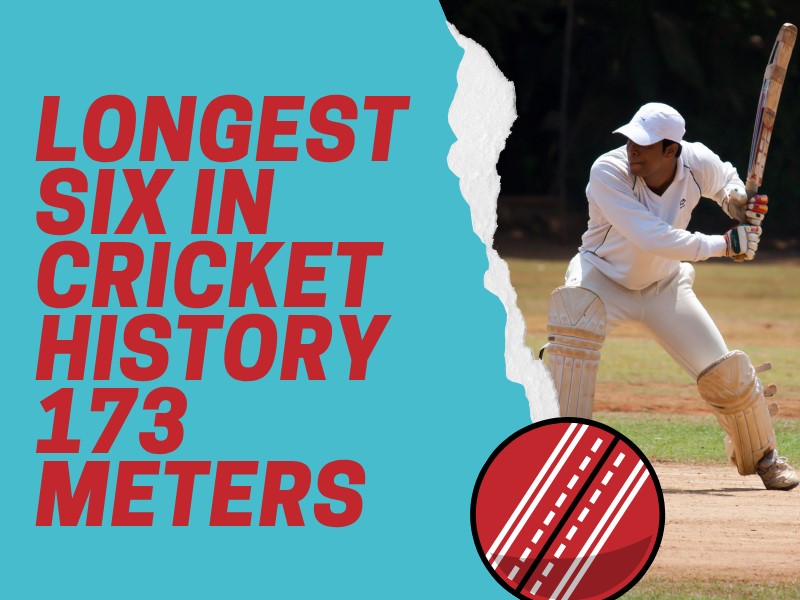
longest six in cricket history 173 meters
Introduction: Longest Six in Cricket History 173 Meters
There are moments in cricket that make you jump off the couch, scream like a kid, and question the laws of physics. One of those jaw-dropping moments is when a batsman launches the ball so far that you’re left wondering, “Did that just leave the stadium — or the planet?”
As a cricket lover, I’ve seen countless sixes. From Chris Gayle’s brute power to MS Dhoni’s helicopter flicks, every big hit has its own story. But nothing quite matches the curiosity and the buzz around the longest six in cricket history — the 173-meter monster shot that still sparks debates across the cricketing world.
So, let’s dive into this — the facts, the myths, and the madness behind that record-breaking smash.
Table of Contents
The Craze for Long Sixes – Why They Captivate Fans
Before we get into who hit that 173-meter six, let’s admit something — we all love big hits. There’s something magical about watching a white ball disappear into the night sky. It’s like watching a firework, except it’s powered by pure muscle, timing, and courage.
As a fan, whenever a batsman steps down the track, I feel that mix of excitement and tension. Will it clear the ropes? Will it go into the stands? Or will it land on someone’s rooftop? That’s the charm of cricket — it’s not just a sport; it’s theatre on grass.
Long sixes are more than just numbers; they symbolize dominance. They make the bowler question his existence, the fans erupt in cheer, and the commentators lose their voice for a second. It’s the ultimate “I own this moment” statement in cricket.
The Mythical 173-Meter Six – Who Hit It?
The internet is flooded with claims that Shahid Afridi hit a 173-meter six, and while that number sounds unbelievable, the story behind it is fascinating.
Here’s what really happened — during a match against South Africa in 2013, Afridi struck a ball so high and so far that it reportedly traveled over 158 meters, but unofficial sources and viral videos began circulating, calling it 173 meters.
To be fair, there’s a bit of controversy around the measurement. Official cricket bodies like the ICC never verified a 173-meter hit, and experts suggest that even the most powerful modern batsmen rarely exceed 125–130 meters under normal atmospheric conditions.
Still, fans, especially those in Pakistan, swear by it — and honestly, who can blame them? When Afridi was in full flow, physics often took a back seat.
Did the 173-Meter Six Really Happen?
Here’s the truth — no official record supports a 173-meter six.
It’s more of a cricketing legend than a confirmed stat. But legends have power, don’t they?
Let’s break it down scientifically. For a cricket ball to travel 173 meters, it would need unreal bat speed and launch angle — something close to 150 km/h of ball velocity with a near-perfect connection. That’s closer to the realm of golf drives than cricket.
Even the biggest hitters like Chris Gayle, Andre Russell, and MS Dhoni have officially recorded sixes between 115 to 125 meters. So, while 173 meters might stretch the truth, the story adds to Afridi’s larger-than-life aura — the man who could make the impossible seem possible.
Other Longest Sixes in Cricket History
Let’s step aside from the mythical and talk about official records — because some of these hits were truly out of this world.
| Player | Distance (in meters) | Match/Year | Opponent |
|---|---|---|---|
| Shahid Afridi | 158m (unofficial) | vs South Africa, 2013 | South Africa |
| Brett Lee | 143m | vs West Indies, 2005 | West Indies |
| Martin Guptill | 127m | vs South Africa, 2012 | South Africa |
| Liam Livingstone | 122m | vs Pakistan, 2021 | Pakistan |
| Corey Anderson | 122m | vs India, 2014 | India |
| Yuvraj Singh | 119m | vs Australia, 2007 | Australia |
| MS Dhoni | 112m | vs New Zealand, 2009 | New Zealand |
| Chris Gayle | 120m | Multiple Matches | Various |
These shots weren’t just about distance — they were statements of intent. Brett Lee’s six came from a fast bowler, which is rare, and Martin Guptill’s hit at Wellington literally disappeared into the stands before anyone could track it.
My Favorite Long Six Moment
If I had to pick a personal favorite, it would be MS Dhoni’s World Cup final six in 2011. It might not be the longest on record, but emotionally, it’s the biggest six ever hit by an Indian captain. The way he finished that match — calm, poised, and powerful — gave an entire nation goosebumps.
Every time I see the replay, I get chills. That wasn’t just a six; that was history, pride, and relief packed into one swing.
The Science Behind Long Sixes
Ever wondered what makes a six travel so far? It’s not just about power. It’s a perfect cocktail of timing, bat speed, launch angle, and atmospheric conditions.
Here’s a simplified breakdown:
- Bat Speed: The faster the swing, the higher the exit velocity. Players like Chris Gayle generate immense bat speed using their strong core and upper body.
- Timing: Even a slower batsman can hit long if the timing is perfect. It’s like hitting the sweet spot on a guitar string — everything just clicks.
- Angle of Launch: The ideal angle for maximum distance is around 35 to 40 degrees. Too high and it loses momentum; too flat and it won’t clear the rope.
- Altitude & Wind: Matches played at high altitudes (like in Johannesburg) or with tailwinds can make sixes go farther than usual.
In short, it’s part physics, part art, and a lot of instinct.
Modern Power-Hitters Who Could Break the Record
Cricket today is filled with muscle-bound hitters who treat boundaries like warm-up targets. If anyone were to break the mythical 173-meter mark, it would likely be one of these modern-day monsters:
- Liam Livingstone (England):
His 122-meter hit against Pakistan showed he’s got the raw power and modern gear to push boundaries — literally. - Andre Russell (West Indies):
Russell doesn’t hit sixes — he launches missiles. His combination of strength and explosive timing could one day challenge the longest-hit list. - Glenn Maxwell (Australia):
Unorthodox, fearless, and wildly creative — Maxwell’s reverse sweeps and switch hits have the potential to rewrite six-hitting science. - Tim David (Australia):
The Singapore-born Aussie has made a name for himself in T20 leagues. With his raw strength, he’s a dark horse for the future “longest six” title. - Shubman Gill (India):
While not a pure power-hitter, Gill’s clean technique and precise timing often make the ball sail effortlessly — a modern-day combination of grace and muscle.
Technology and the Evolution of Six-Hitting
It’s worth noting that sixes are getting longer — not necessarily because players are stronger, but because technology has revolutionized the game.
- Bats are lighter yet more powerful. The “sweet spot” is now wider, meaning even mishits can clear the ropes.
- Fitness levels have skyrocketed; today’s cricketers train like sprinters and lift like athletes.
- Data analytics and high-speed cameras help players fine-tune their hitting technique for maximum distance.
In short, cricket has evolved from elegant drives to explosive entertainment.
Why the 173-Meter Six Still Matters
Even though the 173-meter six remains unverified, it holds a special place in cricket folklore. It represents the wild, unpredictable, and thrilling side of the game we all love.
Every fan, no matter which country they support, has that one favorite big hit that lives rent-free in their memory. And that’s the beauty of cricket — it’s not always about records; sometimes, it’s about the magic.
Final Thoughts – Beyond the Numbers
So, did Shahid Afridi really hit a 173-meter six? Probably not — but does it matter? Not really. Because what matters is the emotion that story brings.
When you hear “173 meters,” your imagination runs wild — you picture the ball soaring over the stadium, past the crowd, maybe even landing on the highway. It’s that “wow” factor that keeps cricket fans hooked generation after generation.
And who knows — maybe someday, with the evolution of strength, bat tech, and pure aggression, someone will actually hit a six close to that mythical mark. Until then, the 173-meter six remains cricket’s most fascinating legend — part fact, part folklore, and entirely unforgettable.
About the Author