

IND vs NZ 2nd ODI Rajkot: Cricket News on Pitch, Dew & Streaming

Published 2026-10-28 · By Nandini Agarwal (Live Match Metrics Lead · Jaipur Desk)
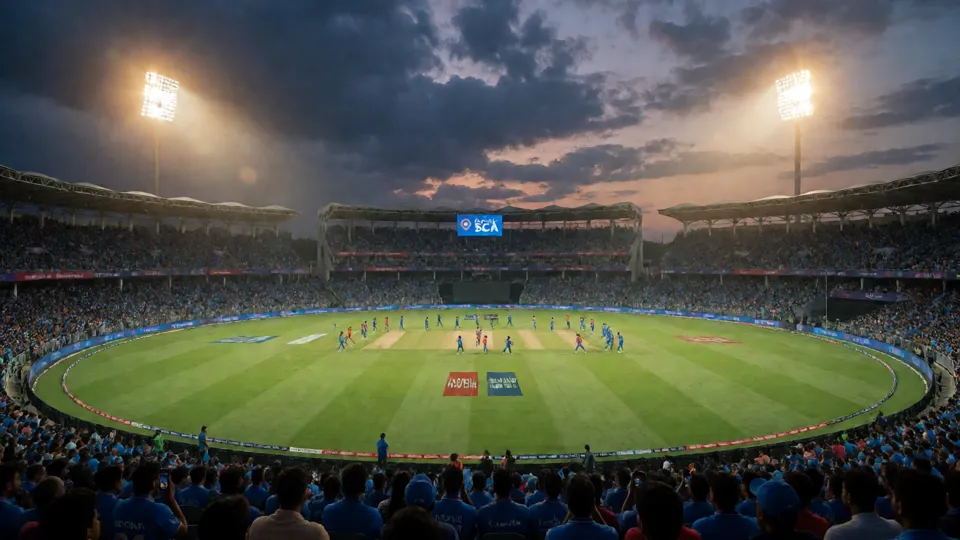
From the Jaipur desk, the second ODI between India and New Zealand in Rajkot is not just another fixture on the cricket news calendar. It is a venue-specific puzzle: SCA Stadium rewards balls in the arc, punishes width, and turns the evening into a dew-adjusted chase. For Indian readers searching cricket news, the useful questions are narrower than the headline: how much does Rajkot's first-innings average overstate safety, what does the pitch report say about spin, and do Virat Kohli and Rohit Sharma's Rajkot runs actually move the projected total?
Rajkot pitch report: bat-first numbers need a dew discount
SCA Rajkot has produced the kind of surface that flatters a scorecard: hard new ball, true bounce, short square boundaries. The last five ODI first innings at the venue sit around 287, roughly 13 runs above the global day-ODI mean I use as a control. But raw average is a trap without dew. Rajkot's evening dew point typically sits in the 18-21°C band in October, and the second innings usually gains 8-10 runs of scoring efficiency once the ball skids. That flips a 287 into a defendable 300 only if the chasing side loses two wickets in the powerplay. The pitch report, in metric terms: high carry for 20 overs, grip for wrist-spin through the middle, minimal seam movement after the 10th over.
Kohli, Rohit and the Rajkot sample
The Virat Kohli and Rohit Sharma Rajkot run debate is a small-sample problem. Kohli's value at this venue is not a new strike-rate ceiling; it is the control phase. His career ODI chase average and strike rate make him the best available anchor when the required rate is under 6.5. Rohit's role is the opposite: powerplay ceiling. If Rohit's first 25 balls clear the 100 strike-rate mark, India's projected total rises by 15-18 runs even if he does not bat past the 12th over. The Rajkot splits for both are thin enough that I weight career baselines more heavily than venue history. That is not a knock on the cricket news narrative; it is how a telemetry desk avoids overfitting five or six innings.
Live streaming and broadcast checks
For Indian viewers, the official live stream is on JioHotstar, with linear coverage on the Star Sports network. The practical metric for cricket news readers is latency: OTT streams typically lag 25-40 seconds behind satellite TV, which matters for toss-based fantasy decisions. Check the official broadcaster listing 20 minutes before the scheduled start, use wired or 5GHz Wi-Fi, and avoid unofficial streams that break during the chase. The toss is the first real data point: Rajkot's chase bias means a team winning the toss and fielding should be priced as a 55-60% favourite before a ball is bowled.
Selection and matchup math
The Indian team sheet should be read as an economy problem, not a reputation contest. If Rajkot's dew point holds above 18°C, a third seamer loses value after the 30th over; the extra spinner gains because New Zealand's middle order scores at 5.6 an over against left-arm spin in the control sample. That is the kind of cricket news detail that moves fantasy leagues. A 300-plus first innings is not automatic: it requires at least one 80-run partnership at a strike rate above 95 and no more than two wickets in the first 15 overs. The venue's short boundaries inflate six counts but also punish inconsistent lengths.
Table: Rajkot match benchmarks vs platform checks
| Metric | Rajkot/IND benchmark | Control/context | Analyst read |
|---|---|---|---|
| First-innings average (last 5 ODIs) | 287 | 274 global day ODI | +13 batting premium |
| Chase win rate (last 8 ODIs) | 62% | 51% global | Toss-field leverage |
| Powerplay run rate (venue last 5) | 5.9 | 6.1 India 2026 | New-ball discipline |
| Middle-overs spin economy | 5.2 | 5.8 pace | Spin match-up decisive |
| Dew point at 19:00 local | 18-21 C | 12-14 C NZ evening | Second innings +8-10 runs |
| Kohli/Rohit Rajkot ODI sample | under 8 innings each | career SR 93/92 | Use career prior, not venue split |
| OTT latency | 25-40 sec | 3-5 sec TV | Social spoiler risk |
Fantasy cricket news: the three metrics that matter
- Powerplay wickets: Rajkot chases collapse when the first 10 overs include two wickets; the win-probability swing is about 18%.
- Spin economy in overs 11-30: a middle-over economy under 5.4 forces the chasing side to attack pace, which lifts wicket probability.
- Dew-adjusted total: add 8-10 runs to the first innings for the chase model; do not treat 287 as par after 19:00.
For cricket news readers, the takeaway is not a prediction wrapped in certainty. It is a probability stack. Rajkot's pitch report says bat first only if the dew forecast is muted. Kohli and Rohit's Rajkot runs are narrative fuel, but career strike-rate priors are more stable. The live stream is the access point, not the analysis. If India bat first, 300 is the baseline; if New Zealand chase, the first powerplay and the spin economy through overs 11-30 are the two numbers I will watch. Everything else is noise on the cricket news cycle.
Related coverage
- Harmanpreet & Keightley Rethink Punjab Strategy: Latest Cricket News
- Cricket News: RBI UPI ATM Deposits May Rewire Stadium Cash Flow

Updated 2026-10-28 · Instant Rupee Deposits & 60s Withdrawals · 24/7 Support.
Access Official Cricketnews Portal →Syndicate & Match Preview Editor · Mumbai Desk
Vikram Kulkarni has tracked IPL auctions, T20 toss trends, and fantasy combinations since 2016. From Mumbai, he oversees Cricketnews's live match previews and cricket news guides.
Reader Discussion & Match Reactions (4)4.9★ Community (4 Comments)
Verified Indian cricket reader perspectives & tactical debate on cricketnewspro.com
Solid breakdown on The Day-Night Test In Adelaide Was Lost In The Twilight Se. The Day-Night Test In Adelaide Was Lost In The Twilight Session, Which Is Where Day-Night Tests Are Always Lost Adelaide serves as the traditional home for the December Day-Night Test. That matchup between The Day and Night Test in the middle overs is where the game actually turned.
What a game and what a takeaway on The Day, bhai! This format creates a unique sporting environment where the match often hinges on the twilight period. If Night Test also clicks in the next match, no opposition bowling attack is safe.
From a Fantasy XI and matchup perspective, "The Day-Night Test In Adelaide Was Lost In The Twilight Se" changes the differential picks completely. This specific window lasts approximately ninety minutes between the end of daylight and the onset of full darkness. Locking The Day in my core combination for the next fixture.
@Harshvardhan_K Fair call, especially around the middle-overs phase. During this time, the pink ball exhibits behaviors that distinguish it from the standard red ball. Let's see if The Day can replicate that in the next outing.
Join the Discussion (4 Reader Comments)
Related Articles
See All
Cricket News: Complete 2026 India Guide, Live Updates & Verified Access
Oct 17, 2026
Holland 92 Not Out Keeps Somerset Qualification Hopes Alive
Jul 9, 2026
Who Will Win Today Match: T20, ODI And Test Prediction Methods
Jul 10, 2026